
- Education
- Forex Technical Analysis
- Basic Concepts
- Support and Resistance
Forex Support and Resistance - Support and Resistance Trading
Every price chart tells a story — and support and resistance are the plot points where that story changes direction. In the forex market, where trillions of dollars change hands daily, price does not move randomly.
It gravitates toward specific levels where buying and selling pressure have historically converged, stalled, or reversed. Understanding these levels is not optional for serious traders — it is the foundation upon which entries, exits, stop losses, and profit targets are built.
This article breaks down what support and resistance are, how to identify them accurately, and how to trade them with discipline and precision.

What is Support and Resistance in Trading
Support and resistance are price levels on a forex chart where the market has repeatedly struggled to move beyond, creating identifiable boundaries between buying pressure and selling pressure. Support is a level at which demand is strong enough to prevent price from falling further — essentially a floor beneath the market. Resistance is the opposite: a level where selling pressure is sufficient to cap upward movement, acting as a ceiling above price.
These levels exist because of market memory. Traders, institutions, and algorithms all reference the same historical price data. When price approaches a level where it previously reversed, a significant portion of market participants expect the same reaction — and their collective behaviour often makes it happen. This is what gives support and resistance their predictive power.
In practical terms, support and resistance manifest in several forms:
- Horizontal levels - fixed price zones where price has bounced or reversed multiple times.
- Dynamic levels - moving averages or trendlines that shift with price over time.
- Psychological levels - round numbers such as 1.2000 on EUR/USD or 150.00 on USD/JPY, where large orders tend to cluster.
- Structural levels - swing highs and swing lows that mark the turning points of a trend.
How to Trade Support and Resistance
Trading support and resistance is about positioning yourself at levels where the market has a demonstrated tendency to react — and managing your risk around those reactions. There are two primary approaches: trading the bounce and trading the break.
1. Identify high-quality levels
Not all support and resistance levels are equal. Focus on levels that have been tested multiple times, are visible on higher timeframes (H4, Daily, Weekly), and align with other technical confluences such as Fibonacci retracements, moving averages, or previous session highs and lows. The more confluences a level has, the more reliable the signal it generates.
2. Wait for price to approach the level
Patience is a core skill when trading support and resistance. Avoid entering in anticipation of the level — let price come to it. Watch how price behaves as it approaches: is momentum slowing? Are candles compressing? These are early signs that the level is being respected.
3. Look for confirmation at the level
Before entering, wait for a confirmation signal that price is reacting to the level as expected. Common confirmation signals include reversal candlestick patterns (pin bars, engulfing candles, inside bars), a slowdown in momentum on an RSI or MACD indicator, or a sharp rejection wick at the level.
4. Enter the trade with a defined risk
Place your entry at or just beyond the confirmation signal. Set your stop loss beyond the support or resistance level — not at it. If you are buying at support, your stop should sit below the zone, not at the top edge of it. This accounts for the natural volatility that occurs around key levels.
5. Define your target using the next key level
Set your take-profit at the next significant support or resistance level in the direction of your trade. Avoid holding through major opposing levels unless your analysis strongly supports a breakout. Use a minimum risk-to-reward ratio of 1:2 to ensure profitability over a series of trades, even with a sub-50% win rate.
6. Manage the trade actively
Once the trade is live, monitor how price behaves at interim levels. Consider moving your stop loss to breakeven once price has moved in your favour by the equivalent of your initial risk. If trading a breakout, watch for a retest of the broken level — a common occurrence that offers a secondary entry opportunity.
How to Draw Support and Resistance Lines
Support and resistance levels form an essential part of technical analysis used to identify the trend and make trading decisions. They test, as well as confirm trends and should be applied by every trader who uses technical analysis.
Support level is marked by a line which connects previous lows. Depending on the primary trend (prevailing direction of price movements) it can be marked either by a sloping line or a horizontal line.
- In an upward trend the trendline connecting the lows is considered a support with positive slope.
- In a sideways trend the lower trendline is considered a horizontal support.
Resistance level is marked by a line connecting previous highs. Depending on the primary trend a resistance level can also be marked either by a sloping line or a horizontal line.
- In a downward trend the trendline connecting the highs is considered a resistance with negative slope.
- In a sideways trend the upper trendline is considered a horizontal resistance.
For identifying an uptrend each successive support level should be higher than the preceding one and each successive resistance level should be higher than the one preceding it. Otherwise, for instance, when the support level falls down to the previous low, this indicates that either the uptrend comes to an end or at least it changes into a sideways trend.
Conversely, for identifying a downtrend each successive support level should be lower than the previous one and each successive resistance should be lower than the previous one. When a support level comes higher than the previous one, this signals a change in the existing trend.
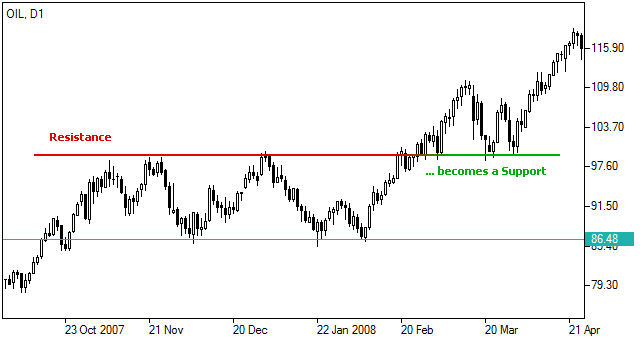
An uptrend is inclined to reverse into a downtrend once the successive higher highs and higher lows change into successive lower highs and lower lows. And conversely, a downtrend can reverse into an uptrend when the lower highs and lower lows turn into successive higher highs and higher lows. In other words, a resistance level becomes a support level, and a support level becomes a resistance level.
This kind of reversal at support and resistance levels in technical analysis is referred to as “rally”, “correction” or “trend reversal”.
- In case a support level is broken below (plus certain deviation is possible), investors may assume that the price will keep on falling. The former support becomes a new resistance level which is expected to hold rallies.
- In case a resistance level is broken above (plus certain deviation is possible), investors may assume that the price will keep on growing. The former resistance becomes a new support level which is expected to hold declines.
The trend is expected to continue as long as the asset price remains between support and resistance levels.
How to Determine Support and Resistance in Forex Trading
Identifying support and resistance is a systematic process, not guesswork. The goal is to locate price zones — not precise lines — where the market has demonstrated a clear and repeated response. Here is a step-by-step framework for doing that accurately and consistently.
1. Begin with the higher timeframes
Start your analysis on the Weekly or Daily chart before moving to your trading timeframe. Levels that form on higher timeframes carry significantly more weight because they reflect the decisions of larger market participants — institutional traders, central bank watchers, and macro-driven funds. Mark every obvious price zone where major reversals, prolonged consolidations, or sharp rejections have occurred. These become your primary levels.
2. Work down through the timeframes
Once your higher-timeframe levels are marked, move to the H4 and H1 charts and repeat the process. Add levels that are clearly significant at these timeframes without cluttering your chart with every minor fluctuation. This top-down approach gives your analysis a hierarchy: higher-timeframe levels take precedence and act as the strongest decision zones, while lower-timeframe levels refine your entry and exit precision.
3. Mark swing highs and swing lows
The most reliable support and resistance levels are built from prior swing highs and swing lows — the points where price last made a clear directional decision. A prior swing high becomes resistance; a prior swing low becomes support. Mark the most recent and most significant of these structural points on each timeframe. The more pronounced the swing, the more meaningful the level.
4. Look for confluence zones
A level gains strength every time an additional factor aligns with it. When a horizontal support zone coincides with a 61.8% Fibonacci retracement, a round psychological number such as 1.1000 or 150.00, and the 200-period moving average, that zone is far more significant than any one of those factors in isolation. Identify these confluence areas and treat them as your highest-priority levels — the ones most likely to produce a strong and tradeable market reaction.
5. Assess level strength and freshness
Not all levels carry equal weight. A zone that has been tested and respected three or more times is stronger than one touched only once. However, repeated tests also gradually deplete the orders that defend a level — meaning heavily tested zones are more likely to eventually break. Pay particular attention to "fresh" levels: those that have not been retested since they first formed. Fresh levels tend to produce the sharpest and most reliable price reactions when visited again.
6. Apply the principle of role reversal
One of the most powerful concepts in support and resistance analysis is role reversal — the tendency of broken support to become new resistance, and broken resistance to become new support. When price closes decisively beyond a key level, that level does not disappear from your analysis; it flips. Monitor for a retest of the broken level from the other side, as these retests frequently offer high-probability trade entries in the direction of the break.
7. Keep your levels current
Support and resistance analysis is not static. As new price action develops, some levels become obsolete while new ones form. Regularly review and update your chart — remove levels that have been convincingly broken and no longer show any sign of relevance, and add newly formed swing points that the market has clearly responded to. A clean, current chart is a more useful trading tool than one cluttered with outdated levels.
Support and Resistance Trading Strategy
The rationale of support level is that as the price gets closer to this area, buyers see a better deal and are willing to buy, while sellers see a worse deal and are less likely to sell. However, support cannot always hold prices. And when prices break below the support level this indicates that sellers may have a good opportunity to sell the asset.
On the other hand, the main premise behind resistance is that as the price gets closer to the resistance level sellers get more willing to sell an asset, while buyers will be less inclined to buy. A break above the resistance level indicates an increased willingness to buy.
A reversal between support and resistance levels can be either a positive or a negative change against the prevailing trend. It is crucial for analysts and market participants, because depending on the signals of these patterns they adopt a trading strategy on the same security.

Not sure about your Forex skills level?
Take a Test and We Will Help You With The Rest
You can see the graphical object on the price chart by downloading one of the trading terminals offered by IFC Markets.