- Education
- Forex Technical Analysis
- Technical Indicators
- Bill Williams Indicators
- Fractals Indicator
Williams Fractal Indicator
Williams Fractals provide a mathematical lens through which traders can observe the underlying geometry of market movements, pinpointing potential trend reversals with high precision. By identifying specific price patterns that repeat across various timeframes, this tool allows market participants to distinguish between minor price fluctuations and significant structural shifts.
Key Moments
Professional traders prioritize specific instances when utilizing this indicator to ensure maximum efficacy:
- The Fifth-Bar Confirmation: A fractal is only considered valid once the fifth candle in the sequence has closed. Entering before this confirmation risks acting on a "repainting" signal that may disappear if price action changes.
- Support and Resistance Mapping: Fractals often highlight "peaks" and "troughs" that institutional players use as liquidity pools, making them ideal for identifying horizontal support and resistance levels.
- The "Alligator" Filter: To avoid false signals in sideways markets, fractals are most effective when filtered through the Williams Alligator. A "buy" signal is typically only taken if it occurs above the Alligator’s Teeth (the red line).
- Stop-Loss Placement: Because fractals represent local highs and lows, they provide objective, non-discretionary points for placing stop-loss orders to protect capital.
- High-Timeframe Synthesis: While fractals appear on all charts, those formed on Daily or Weekly timeframes carry significantly more weight and are less prone to market "noise" than those on lower timeframes.
What is Fractal Indicator
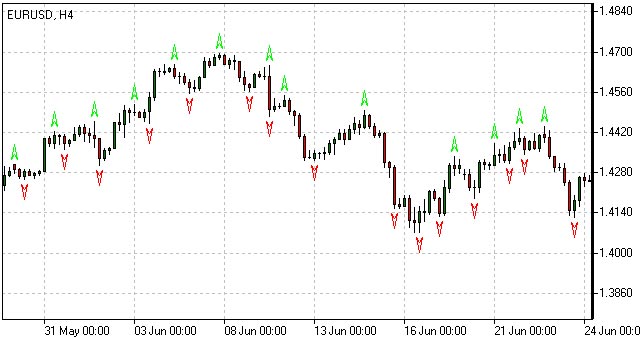
Fractal indicator is a momentum-based technical analysis tool that highlights a specific five-bar pattern where the middle bar possesses the highest high or the lowest low of the group. While the term "fractal" suggests infinite complexity, in the context of trading, it simply refers to a recurring pattern that signals a potential turning point in price. These signals are visualized on charts as small arrows or triangles above or below the price bars.
How to Use Fractals Indicator
Effective application of the Williams Fractal requires a disciplined approach to entry and risk management:
- Breakout Strategy: One of the most common uses is the "Fractal Breakout". A trader places a buy-stop order slightly above a recent bullish fractal or a sell-stop order slightly below a recent bearish fractal. A breach of these levels suggests a continuation of momentum.
- Trend Confirmation: In a trending market, traders look for a series of broken fractals. In an uptrend, price should consistently break above the "up" fractals, while "down" fractals remain intact.
- Risk Mitigation: By placing stop-losses at the tip of the most recent fractal in the opposite direction of the trade, market participants can ensure they exit a position as soon as the market structure shifts against them.
- Indicator Synergy: Professionals rarely use fractals in isolation. They are frequently paired with oscillators like the Awesome Oscillator (AO) or the Relative Strength Index (RSI) to confirm that momentum supports the fractal signal.
Fractals Indicator
How Does Fractal Indicator Work
The mechanics of the Williams Fractal are rooted in a strict five-bar sequence. The indicator looks for a "central" bar that stands out from its immediate neighbors.
For a Bullish Fractal (Up Fractal), the mathematical requirement for the high (H) at bar n is:
H(n) >H(n-2) and H(n) >H(n-1) and H(n) >H(n+1) and H(n) >H(n+2)
For a Bearish Fractal (Down Fractal), the mathematical requirement for the low (L) at bar n is:
L(n) < L(n-2) and L(n) < L(n-1) and L(n) < L(n+1) and L(n) < L(n+2)
Because the calculation requires two bars to close after the signal bar (n+1 and n+2), the indicator is inherently lagging. However, this delay provides the necessary confirmation that a local peak or trough has indeed been established.
Fractal and Alligator Strategy
As we mentioned above, fractals work more productively combined with Alligator Indicator. There is a special strategy, designed by Williams, which is quite simple and understandable. Let’s have a look at how it works.
Alligator not only filters and clears the signals generated by Fractals Indicator but can help find the best entry points. In particular, it is recommended to go long, when a buy fractal is above the red line of the Alligator Indicator (Alligator’s teeth). And, when a sell fractal is below the red line of the Alligator Indicator, it’s recommended to go short.
Traders apply this approach to both the Forex and Stock markets.
Bottom Line: Fractal Indicator Features
- Besides displaying the local highs/lows, fractals help traders identify support and resistance lines for selected instruments.
- Fractal indicator can be applied on any timeframe.
- Fractals appear on a chart very frequently, and trading all of them will be a waste of money and time. That’s why traders use other indicators to filter their signals.
- Fractals are usually redrawn and they always lag behind by 2 bars or even more, so traders should be very careful when trading fractals and combine them with other indicators and oscillators.
- Fractals are more reliable on larger timeframes, but in that case, they give fewer signals.
Forex Indicators FAQ
What is a Forex Indicator?
Forex technical analysis indicators are regularly used by traders to predict price movements in the Foreign Exchange market and thus increase the likelihood of making money in the Forex market. Forex indicators actually take into account the price and volume of a particular trading instrument for further market forecasting.
What are the Best Technical Indicators?
Technical analysis, which is often included in various trading strategies, cannot be considered separately from technical indicators. Some indicators are rarely used, while others are almost irreplaceable for many traders. We highlighted 5 the most popular technical analysis indicators: Moving average (MA), Exponential moving average (EMA), Stochastic oscillator, Bollinger bands, Moving average convergence divergence (MACD).
How to Use Technical Indicators?
Trading strategies usually require multiple technical analysis indicators to increase forecast accuracy. Lagging technical indicators show past trends, while leading indicators predict upcoming moves. When selecting trading indicators, also consider different types of charting tools, such as volume, momentum, volatility and trend indicators.
Do Indicators Work in Forex?
There are 2 types of indicators: lagging and leading. Lagging indicators base on past movements and market reversals, and are more effective when markets are trending strongly. Leading indicators try to predict the price moves and reversals in the future, they are used commonly in range trading, and since they produce many false signals, they are not suitable for trend trading.

Was this article helpful?

Not sure about your Forex skills level?
Take a Test and We Will Help You With The Rest