How Big Corporations Legally Avoid the 21% Tax
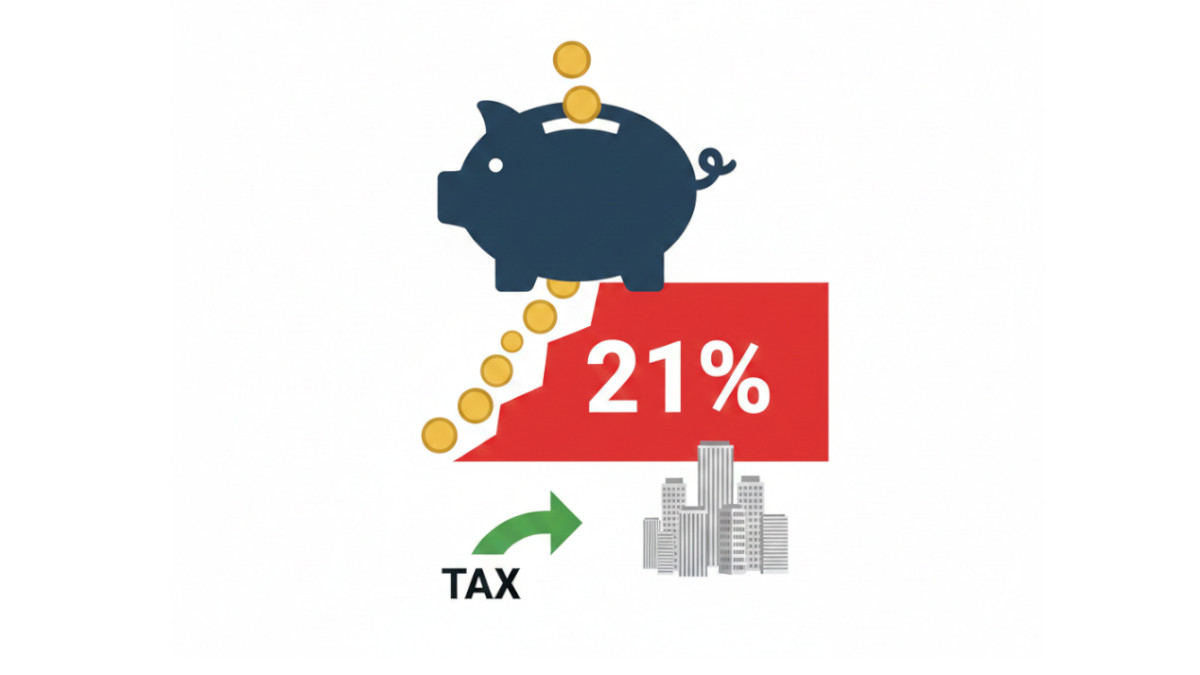
The U.S. corporate tax rate is officially 21%. In theory, that is what profitable companies are supposed to pay. But in practice, large and sophisticated corporations consistently pay far less, sometimes close to zero, without breaking the law.
It is the result of a tax system designed around incentives, timing rules, and accounting asymmetries that favor scale and complexity. And JPMorgan Chase is a shining example of that.
The Illusion of the 21% Corporate Tax Rate
The 21% rate functions more as a headline number. Big corporations calculate their taxes using a layered system of deductions, credits, and accounting differences that allow them to reduce their effective tax rate dramatically.
This is why Congress decided to implement a desperate 15% corporate minimum tax in the Inflation Reduction Act of 2022. The law shows that lawmakers no longer expect the largest firms to pay the statutory rate, at least they won’t reduce their taxes all the way to zero.
How Large Corporations Legally Avoid Taxes
1. Accelerated Depreciation
Corporations are allowed to deduct the cost of assets much faster for tax purposes than for financial reporting. For banks like JPMorgan, this includes:
- Technology infrastructure
- Trading systems
- Data centers
- Software development
- Equipment tied to operations and compliance
While these assets generate value for many years, tax rules allow large portions of the cost to be deducted immediately. For a firm that reinvests continuously at massive scale, the result is perpetual deferral: taxes that are theoretically owed later are never fully paid because new deductions constantly replace old ones.
2. Stock Based Compensation
JPMorgan pays senior executives heavily in stock and stock options. Under accounting rules, the company records an estimated compensation expense at the time the equity is granted, based on the stock’s value then. That expense is fixed and does not increase if the stock price later rises.
Tax law works differently. When the stock vests or options are exercised, the company can deduct the actual market value at that time. If the share price has climbed significantly, the tax deduction can be far larger than the expense ever shown in financial statements.
Investors see strong reported profits, while the IRS sees much lower taxable income. Executives benefit from higher stock prices, shareholders benefit from lower taxes, and the gap between accounting expense and tax deduction can wipe out billions in taxable income.
3. Credits and Incentives
Although banks are not traditionally associated with R&D in the public imagination, financial institutions aggressively claim credits for software development, quantitative modeling, AI and algorithmic systems and risk-management technology.
These credits reduce taxes dollar-for-dollar, not just income. JPMorgan has repeatedly emphasized its role as a technology company with a banking license a framing that conveniently aligns with eligibility for innovation incentives.
4. International Structuring
JPMorgan operates in dozens of jurisdictions. That global footprint allows profits to be allocated through internal pricing, service fees, and intellectual property arrangements that shift income away from higher tax environments.
Even after post 2017 reforms designed to curb aggressive profit shifting, multinational banks retain significant flexibility in where profits appear on paper, even when economic activity occurs primarily in the United States.
5. Book Income vs Tax Income
At the center of the system is
- Book income which is reported to shareholders shows stability and growth.
- Taxable income is reported to the IRS and shows deductions, credits, and timing.
JPMorgan can report tens of billions in profits to investors while legally paying a much lower effective tax rate. This gap is precisely what the 15% minimum tax attempts to address, by taxing book income when tax income falls too low.
15% Minimum Tax Is an Admission of Failure
The Inflation Reduction Act is a compromise. Smaller and mid sized companies are expected to pay something close to the full 21% corporate tax rate. Very large corporations, like JPMorgan, are guaranteed they won’t pay less than 15%.
Most companies are expected to comply with the standard tax rules. The biggest and most powerful firms are allowed to optimize their taxes within a lower floor.
So the policy quietly accepts that the largest institutions are too complex, too influential, or too important to the economy to be taxed at the headline rate.
Bottom Line Is
The 21% corporate tax rate still exists on paper. But for institutions like JPMorgan Chase, the real interest rate, what's left after depreciation, payroll deductions, tax breaks, and international structuring is now capped at just 15 percent.
Nový výkonný nástroj, JP Morgan technické informace
Nový výkonný nástroj, JP Morgan technické informace
Živá technická analýza s okamžitou předpovědí s využitím nejoblíbenějších indikátorů a oscilátorů.
Vyzkoušet

If you don’t find a way to make money while you sleep, you will work until you die.- Warren Buffett