

- Education
- About Forex
- What is Forex and How does it Work
What is Forex and How does it Work
If you've ever exchanged currency before, you've already participated in the forex market, even without realising it. At its core, forex is about the relative value of one currency against another, and that relationship is constantly changing. For traders, those changes are where the opportunity lies. Understanding the 10 strongest currencies in the world can help traders identify stable assets for long-term investments.
Key Moments
- The value of a currency is measured by how much another currency can be bought with one unit of it. This is called a price quote.
- Usually there are no problems when trading on Forex, and there is more than enough liquidity.
- The purchasing power of the average trader is usually very small compared to higher level traders that they need a Forex broker or bank to provide a trading account, financial leverage and access to the market via trading servers.
Let's start from the very beginning.
What is Forex
Forex is exchanging one currency for another. You've already done this if you've ever traveled abroad and swapped your home currency for the local one at an airport or bank. The word itself is just short for "foreign exchange," sometimes written as FX.
Later in your educational curve you can learn What is Cryptocurrency as well. But if you are interested, we welcome you to jump start now.
The concept is simple enough, but the scale is massive. Every day, governments, banks, large companies, and everyday traders are all buying and selling currencies around the world. It's one of the biggest and most active markets on the planet.
So why does this matter to you as a trader? Because currency prices are always moving. They go up, they go down, and they rarely stay still for long. That constant movement is what creates trading opportunities, and you can take a position in either direction, whether you think a currency is going up or going down.
What is the Forex Market
The forex market is the largest and most liquid financial market in the world, with an average daily turnover exceeding $7.5 trillion. So you understand how big is the turnover - the global equity market sees less than $300 billion in daily volume, a fraction of forex activity.
Forex trading operates over-the-counter (OTC), meaning trades are conducted directly between participants; banks, brokers, institutions, and retail traders; through a global electronic network.
Decentralised structure is what allows the market to run continuously, five days a week, across every major time zone.
The market is driven by these forces:
- Central banks - Interest rate decisions and monetary policy shifts can move currencies sharply.
- Economic data and news - Strong GDP figures, employment reports, or inflation data attract capital flows into a currency.
- Market sentiment - Trader expectations and risk appetite can accelerate or reverse trends.
 254,697
How does Forex Market Work
Forex market works by simultaneously buying one currency and selling another, the price of a currency pair tells you how much of the quoted currency is needed to purchase one unit of the base currency.
For example, if EUR/USD is trading at 1.0650, it costs $1.0650 to buy one euro.
A few mechanics are essential to understand:
Currency pairs
Every forex trade involves a pair. The first currency listed is the base currency; the second is the quoted currency. When you buy a pair, you're buying the base and selling the quote. When you sell, you're doing the reverse.
For example, buying GBP/USD means you're buying the pound and selling the dollar, you'd do this if you expect the pound to strengthen.
Pips
Price movements in forex are measured in pips - the fourth decimal place of a currency pair. A move from 1.0650 to 1.0660 in EUR/USD is a 10-pip move.
Spread
The spread is the difference between the buy price (ask) and the sell price (bid). This is the primary cost of a forex trade. More liquid pairs, the majors, generally have tighter spreads.
Leverage and margin
Forex is commonly traded on margin. Many brokers offer leverage, meaning you only need to deposit a fraction of the total position value to open a trade.
A 3.33% margin requirement, for example, gives you $100,000 of market exposure for a $3,300 deposit.
Leverage amplifies both gains and losses equally, traders please remember risks.
Trading hours
The forex market opens Monday at 5:00am Sydney time and closes Friday at 5:00pm New York time. Sessions overlap across Asia, Europe, and the US, meaning liquidity and volatility shift throughout the day. The London-New York overlap is typically the most active window.
It is important to understand that a trader can place an order to sell and buy currency that he does not own. Which is called CFD Trading.

What is Forex Trading
Forex trading is the act of speculating on the price movements of currency pairs with the goal of generating profit. Rather than simply exchanging currencies for practical use, traders take positions based on analysis, expecting a currency to strengthen or weaken relative to another.
Here are several tips to approach the market
- Spot forex - Trading a currency pair at its current market price, with no fixed expiry. This is the most common form for retail traders.
- Forex forwards - Agreeing to exchange currencies at a set price on a specified future date. Often used for hedging.
- Forex options - Contracts giving the right, but not the obligation, to buy or sell a currency pair at a set price before a specified date. Useful for directional plays and volatility strategies.
How to Trade Forex
Now that you know basic concepts let’s move on to the next steps.
1. Select a currency pair
When trading forex you will always buy one currency while selling another at the same time. Because of this, you will always trade currencies in a pair. Most new traders will start out by trading the most commonly offered pairs of major currencies, but you can trade any currency pair that is available on the trading platform as long as you have enough money in your account.
2. Analyze the market
Research and analysis is the foundation of trading endeavors. During researching, you’ll find great amount of forex resources, which is overwhelming at first. But as you research a particular currency pair, you’ll find valuable resources that stand out from the rest.
3. Read the quote
You’ll see two prices shown for currency pairs (picture showing base and quote currency). The first rate is the price at which you can sell the currency pair and the second rate is the price at which you can buy the currency pair. Difference between the two rates is called the spread. You can view our live spreads.
4. Pick your position
In Forex trading you can speculate the currency on up and down movements in the market.
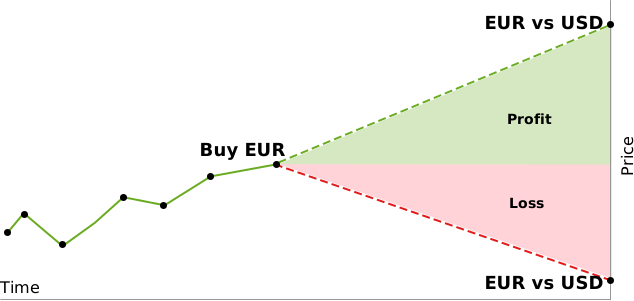
- With a buy position you believe that the value of the base currency will rise compared to the quote currency. For example if you are buying EUR/USD, you believe the price of the euro will strengthen against the dollar.
- With a sell position you believe that the value of the base currency will fall compared to the quote currency. For example if you’re selling EUR/USD, you believe the price of the euro will weaken against the dollar.
History of Forex Market
The history of Forex market is marked by two particular events which put a deep stamp on its formation and development. These two historical events are the creation of Gold Standard System and Bretton Woods System.
Gold Standard and Bretton Woods Systems
Gold Standard System was formed in 1875. The main idea behind it was that governments guaranteed that a currency would be backed by gold. All the major economic countries defined an amount of currency to an ounce of gold as the value of their currencies in terms of gold and the ratios for these amounts became the exchange rates for these currencies. This marked the first standardized means of currency exchange in history. However, World War I caused a breakdown of the gold standard system as countries sought to pursue economic policies which would not be constrained by the fixed exchange rate system of the Gold Standard.
In July 1944 more than 700 representatives from the Allied nations brought forward the importance of a monetary system which would fill the gap left behind the gold standard. They arranged a meeting at Bretton Woods, New Hampshire, to set up a system that would be called the Bretton Woods system of international monetary management. The creation of Bretton Woods System led to the formation of fixed exchange rates as the United States defined the value of US dollar in terms of gold equal to $ 35 for one ounce and other countries pegged their currencies to the dollar. The US dollar became the main reserve currency and the only currency that was backed by gold. However, in 1970 the U.S. gold reserves were so depleted that it was impossible for the U.S. treasury to cover all the reserves held by foreign central banks.
In August 1971 the U.S. announced it would no longer exchange gold for the U.S. dollars that foreign central banks had in reserve .This was the end of Bretton Woods System and the beginning of Forex Trading System.
FAQs
How does Forex Work?
Forex (Foreign Exchange) is a huge network of currency traders, who sell and buy currencies at determined prices, and this kind of transfer requires converting the currency of one country to another. Forex trading is performed electronically over-the-counter (OTC), which means the FX market is decentralized and all trades are conducted via computer networks.
What is Forex Market?
The Forex market is the largest and most traded market in the world. Its average daily turnover amounted to $6,6 trillion in 2019 ($1.9 trillion in 2004). Forex is based on free currency conversion, which means there is no government interference in exchange operations.
What is Forex Trading?
Forex trading is the process of buying and selling currencies at agreed prices. Most currency conversion operations are carried out for profit.
What is The Best Forex Trading Platform?
IFC Markets offers 3 trading platforms: MetaTrader4, MetaTrader5, NetTradeX. MT 4 Forex trading platform is one of the most downloaded platforms which is available on PC, iOS, Mac OS and Android. It has different indicators necessary for making accurate technical analysis. NetTradeX is another trading platform offered by IFC Markets and designed for CFD and Forex trading. NTTX is known for its user-friendly interface, reliability, valuable tools for technical analysis, distinguished functionality and the opportunity to create Personal Composite Instruments (PCI) which is available specifically on NetTradeX.

Was this article helpful?
 You can study CFD trading more thoroughly and see CFD trading examples in the section How To Trade CFDs Visit Educational Center
 Register with IFC Markets Now
Global Access to Financial Markets from a Single Account
