

- Education
- Forex Technical Analysis
- Chart Patterns
- Reversal Patterns
- Triple Top
Triple Top Pattern - What is a Triple Top in Trading
The triple top is one of the most reliable bearish reversal signals technical traders watch for on price charts. It forms when an asset tests the same resistance level three times without breaking through, signaling fading buying pressure. This guide covers what a triple top means, how it forms, and how to trade it with confidence.
DEFINITION:
The triple top is a price pattern generally formed in an uptrend suggesting following reversal and a drop in prices. It is considered more significant than the double top pattern.
Key Moments
- A triple top pattern forms when price tests the same resistance level three times and fails to break through it.
- The pattern signals a potential bearish reversal after an extended uptrend, warning traders that buying momentum may be fading.
- Confirmation occurs only when price closes below the neckline support that connects the two troughs between the three peaks.
- Traders often combine the triple top with volume analysis and momentum indicators to reduce the risk of false signals.
- The measured target price is typically calculated by projecting the pattern's height downward from the neckline breakout point.
What is a Triple Top in Trading
A triple top in trading is a bearish reversal pattern that forms when the price of an asset reaches the same resistance level three separate times. Each peak fails to push meaningfully higher than the last, signaling that buyers are losing control of the trend. This repeated rejection at resistance suggests that upward momentum is fading and a downside move may be approaching.
The pattern typically appears at the end of a prolonged uptrend, where the market has already made significant gains over weeks or months. Traders watch for three roughly equal highs separated by two moderate pullbacks, forming a recognizable shape with an extra peak. Volume often declines with each successive peak, reinforcing the idea that buying pressure is weakening.
Unlike a double top, which only requires two failed attempts at resistance, a triple top demands three distinct tests of the same price ceiling. This extra confirmation makes the pattern somewhat rarer but often more reliable once it fully forms. Many technical analysts view the third failed breakout as the clearest signal that sellers are beginning to overpower buyers.
Traders across forex, stocks, and commodities markets use the triple top to anticipate potential trend reversals before they fully develop. Recognizing this pattern early can help traders adjust their strategy, tighten stop-losses, or prepare to enter short positions. Understanding its structure is the first step toward using it effectively in a broader trading plan.
How to Trade Triple
Trading a triple top effectively requires patience, confirmation, and a clear plan for entry and risk management. Below are the practical steps traders typically follow once they suspect a triple top is forming.
1. Open a Trading Account
Before you can act on a triple top signal, you need a funded brokerage account with access to the markets you want to trade. You can open a trading account online in just a few minutes by providing basic personal details and verifying your identity.
2. Fund Your Account
Once your account is approved, deposit funds using a bank transfer, card payment, or another method your broker supports. Having sufficient capital in place ensures you're ready to act quickly once the pattern confirms.
3. Choose Your Trading Platform
Select a platform that lets you monitor price action and place orders efficiently, such as MetaTrader 4, MetaTrader 5, or NetTradeX. Each of these platforms offers charting tools that make it easier to spot and confirm chart patterns like the triple top.
4. Identify the Triple Top Pattern
Watch for three peaks forming at approximately the same resistance level, separated by two pullbacks of similar depth. Draw a neckline connecting the two troughs between the peaks to define the key support level to watch.
5. Plan Your Entry and Exit
Wait for price to close below the neckline before entering a short position, since this confirms the pattern rather than assuming it. Set a stop-loss above the most recent peak and calculate your target price using the pattern's height projected downward from the breakout.
6. Monitor and Manage the Trade
Once you're in the trade, track price action and adjust your stop-loss as the move develops in your favor. Staying disciplined about your exit plan helps protect profits if the market reverses unexpectedly.
Is a Triple Top Bearish or Bullish
A triple top is a bearish pattern, signaling that an uptrend is likely losing momentum and may reverse into a downtrend. It forms after repeated failed attempts to break above a resistance level, which shows that sellers are gradually gaining control. This bearish bias makes the pattern useful for traders looking to anticipate downside moves in advance.
The bearish signal becomes stronger once price breaks decisively below the pattern's neckline on increased trading volume. A breakout without meaningful volume can sometimes indicate a false signal, so traders often wait for additional confirmation. Combining the triple top with momentum indicators like the RSI can help validate whether the reversal is genuine.
It's worth noting that no chart pattern is guaranteed to play out as expected, and the triple top is no exception. Occasionally, price will break out below the neckline only to reverse again, a scenario known as a false breakdown. Using proper risk management, including stop-losses, helps traders limit losses if the pattern fails to confirm.
Triple Top Formation
The triple top is represented by three consecutive tops locates roughly at the same level and two bottoms. Resistance and support lines connect the tops and the lows respectively. The resistance is believed to be strong as the price reverses three times from the level where the asset is considered overpriced.
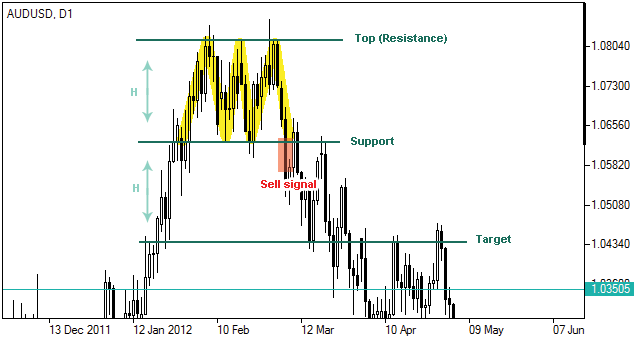
Interpretation of Triple Top
If the price falls below the pattern’s minimum or support level (plus certain deviation is possible), the formation is then completed and can be interpreted as change in direction of the trend downwards serving as a sell signal.
Triple Top Target Price
Following triple top pattern formation the price is generally believed to drop at least to its target level, calculated as follows:
T = S – H, Where:T – target level;
S – support level (recent local lows);
H – pattern’s height (distance between support and resistance levels).
Conclusion
The triple top pattern remains one of the more dependable bearish reversal signals available to technical traders across multiple markets. Its three-peak structure, formed after failed attempts to clear resistance, offers a visual cue that momentum may be shifting. Recognizing this pattern early can give traders a meaningful edge when anticipating potential trend reversals.
Successfully trading the pattern depends on waiting for a confirmed neckline break rather than acting on the third peak alone. Pairing the triple top with volume analysis and momentum indicators helps filter out false signals and improve overall accuracy. A disciplined approach to entries, stop-losses, and target prices remains essential no matter how reliable a pattern appears.
Like any technical pattern, the triple top works best as part of a broader trading strategy rather than a standalone signal. Combining it with sound risk management and a clear understanding of market context can help traders make more informed decisions. With practice, spotting and trading triple tops can become a valuable addition to any trader's toolkit.
Forex Indicators FAQ
What is a Forex Indicator?
Forex technical analysis indicators are regularly used by traders to predict price movements in the Foreign Exchange market and thus increase the likelihood of making money in the Forex market. Forex indicators actually take into account the price and volume of a particular trading instrument for further market forecasting.
What are the Best Technical Indicators?
Technical analysis, which is often included in various trading strategies, cannot be considered separately from technical indicators. Some indicators are rarely used, while others are almost irreplaceable for many traders. We highlighted 5 the most popular technical analysis indicators: Moving average (MA), Exponential moving average (EMA), Stochastic oscillator, Bollinger bands, Moving average convergence divergence (MACD).
How to Use Technical Indicators?
Trading strategies usually require multiple technical analysis indicators to increase forecast accuracy. Lagging technical indicators show past trends, while leading indicators predict upcoming moves. When selecting trading indicators, also consider different types of charting tools, such as volume, momentum, volatility and trend indicators.
Do Indicators Work in Forex?
There are 2 types of indicators: lagging and leading. Lagging indicators base on past movements and market reversals, and are more effective when markets are trending strongly. Leading indicators try to predict the price moves and reversals in the future, they are used commonly in range trading, and since they produce many false signals, they are not suitable for trend trading.

Not sure about your Forex skills level?
Take a Test and We Will Help You With The Rest
You can see the graphical object on the price chart by downloading one of the trading terminals offered by IFC Markets.



Was this article helpful?

 You can study CFD trading more thoroughly and see CFD trading examples in the section How To Trade CFDs Visit Educational Center