
- Education
- Forex Technical Analysis
- Basic Concepts
- Forex Trend
Forex Trend: Trend Lines in Technical Analysis
Reading price action without a trendline is like navigating a city without a map. In the foreign exchange market — the largest and most liquid financial market in the world, with daily trading volumes exceeding $7.5 trillion — identifying the direction of price movement is the single most valuable skill a trader can develop.
Trend lines give that direction a shape, a slope, and a decision point. This article explains what trend lines are, how to draw them correctly, and how to use them to make more confident, structured trading decisions in the forex market.

Key Moments
- Trendlines are commonly used by traders looking to make sure that the underlying trend of an asset is working in favor of their position.
- It takes at least two highs or lows to draw a valid trend line but it takes three to confirm a trend line.
- Trendlines can also experience a failed breakout pattern.
- Longer term trend lines prevail over shorter term ones.
What is a Trendline
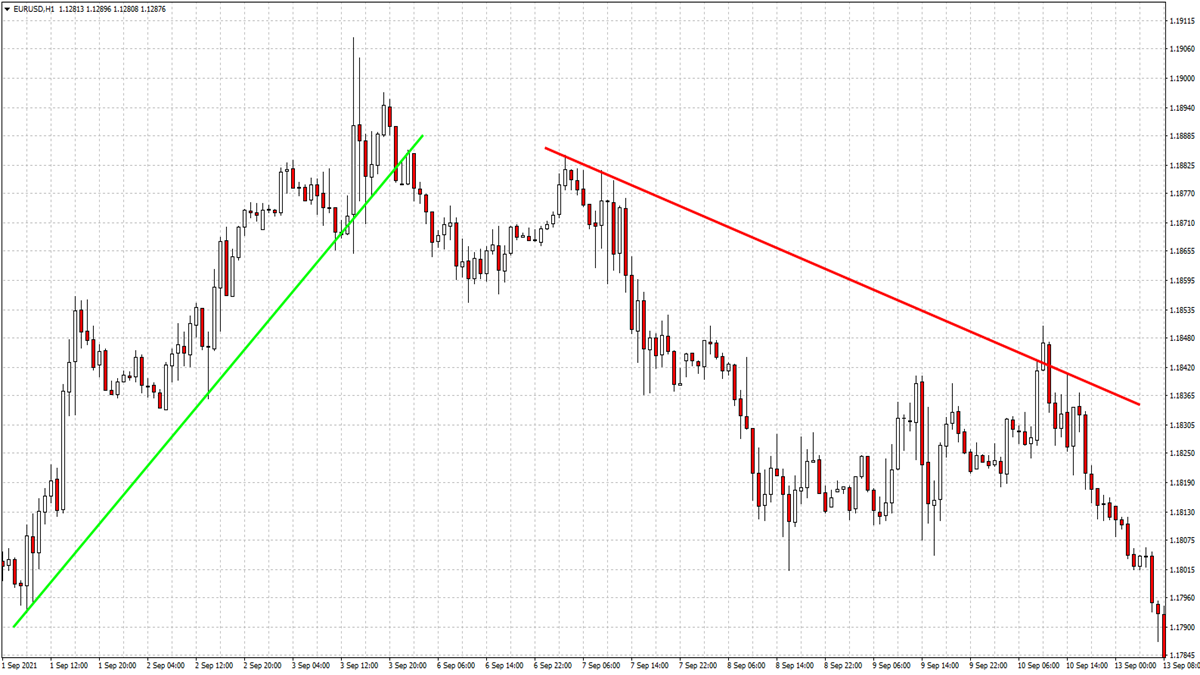
A trendline is a straight line drawn on a price chart that connects two or more significant price points — typically swing highs or swing lows — to visually represent the direction and momentum of a market trend. In essence, it is a dynamic support or resistance level that moves with the price over time. In an uptrend, a trendline is drawn beneath successive higher lows, acting as rising support. In a downtrend, it is drawn above successive lower highs, acting as descending resistance.
Trendlines are one of the oldest and most consistently used tools in technical analysis because they reflect a core market truth: price rarely moves in a straight line, but it does move in a direction. A trendline captures that direction and makes it quantifiable.
In the forex market, trendlines are particularly effective because currency pairs are highly sensitive to macroeconomic momentum — interest rate differentials, trade flows, and risk sentiment all create sustained directional moves that trendlines can track in real time.
There are three types of trendlines traders use:
- Ascending trendline — connects higher lows in an uptrend; functions as dynamic support.
- Descending trendline — connects lower highs in a downtrend; functions as dynamic resistance.
- Horizontal trendline — connects equal highs or equal lows; represents a consolidation zone or range boundary.
How to Draw Trend Lines
Drawing trend lines correctly is more of a discipline than a technique. A poorly placed trendline can lead to false signals; a well-placed one becomes one of the most reliable tools in a trader's chart.
1. Identify the trend direction
Before drawing anything, observe the overall structure of the chart. Is the price making higher highs and higher lows (uptrend), lower highs and lower lows (downtrend), or oscillating between horizontal levels (ranging)? This determines which type of trendline you'll draw and where to anchor it.
2. Locate the anchor points
For an uptrend, identify at least two clear swing lows — points where price reversed upward after a pullback. For a downtrend, identify at least two swing highs — points where price reversed downward after a rally. These anchor points should be significant and clearly visible on the chart, not minor fluctuations within candle wicks.
3. Connect the points with a straight line
Using your charting platform's line tool, connect the two anchor points. Extend the line forward into the right side of the chart. The line should touch the price points as precisely as possible. If using candlestick charts, most traders draw trendlines through candle bodies rather than wicks, as wicks can represent temporary spikes rather than genuine price acceptance levels. That said, both methods are valid — consistency in your approach matters more than which method you choose.
4. Validate with a third touch
Two points draw a line; a third point validates it. When price returns to the trendline a third time and respects it — bouncing off the line without closing beyond it — the trendline is confirmed as a meaningful level. The more times price touches and respects a trendline, the more significant it becomes.
5. Adjust as price evolves
Trendlines are not static. As new swing highs or lows form, you may need to redraw or adjust the trendline to maintain the most accurate angle. A common technique is drawing multiple trendlines at slightly different angles to identify a 'trend zone' rather than a single line.
6. Act on breaks and bounces
There are two primary trading signals generated by trend lines:
- Bounce: Price approaches the trendline and reverses in the direction of the trend. Traders enter in the trend direction, using the trendline as dynamic support or resistance.
- Break: Price closes decisively on the other side of the trendline, often with increased volume or momentum. This signals a potential trend reversal or a significant pullback. A common strategy is to wait for a retest of the broken trendline — which may now act as resistance (if it was previously support, or vice versa) — before entering a trade in the new direction.
Tools and tips for accuracy:
- Use a higher timeframe (4h, Daily) to identify the primary trendline, then drop to a lower timeframe to find precise entry points near that line.
- Zoom out regularly to ensure your trendline reflects the broader market structure, not just recent noise./li>
- Avoid forcing a trendline to fit price. If the angle requires the line to cut through multiple candles, it is likely not a valid trendline.
Types of Trend Lines
Before talking about trendline types, we would like you to remember this simple rules:
- It takes at least two highs or lows to draw a valid trend line but it takes three to confirm a trend line.
- The sharper the trend line you draw, the less reliable it is going to be and the more likely it will break.
- Trend lines become stronger the more times they are tested.
- Never try to force a trendline to fit the market - if it doesn't fit it means the trend line is not valid.
Here we go, the 3 types of trend lines:
- Uptrend - An uptrend line suggests the emergence of higher lows from the price movement, the second low and other lows are always higher than the previous one. It is always drawn and is below the price action. This line is a kind of support line, but with an upward bias. To draw an uptrend line, you need to link well-recognized lows or support areas. Just find the two main bases and connect them with a line. So you have an uptrend line!
- Downtrend - A downtrend line suggests the appearing of lower highs from price movement, the second high always lower, than the first one. It always draws and stands above the price action. This line is some kind of resistance line, but with a downward slope. To draw a downtrend line you need to link well-recognizable highs or resistance areas. Just find two major tops and connect them with a line. Here you have a downward trend line!
- Sideways trend - This is a bit specific price action, because trend suggests some acceleration to upside or downside, but particularly this feature is absent in sideways move. Usually this kind of price action is called “Ranging”. Building a trend line gives the lines a very similar look to support and resistance, because the difference between highs and lows is very shallow. But they are not the same – to build a support or resistance area you need just one point. For any trend line you need two points.
Conclusion
Trend lines are not a relic of old-school charting — they are a living, adaptable tool that remains as relevant in today's algorithmic forex market as they were decades ago. Their power lies in their simplicity: a well-drawn trendline cuts through market noise and reveals the underlying momentum that drives price.
For financial professionals and forex traders, mastering trendlines means developing the patience to identify genuine swing points, the discipline to wait for confirmation, and the judgment to act decisively when price reaches the line. Combined with other forms of technical analysis — such as oscillators, moving averages, or candlestick patterns — trendlines form the structural backbone of a robust trading strategy.
The trend, as the saying goes, is your friend. A trendline simply helps you see it clearly — and trade it with confidence.

Not sure about your Forex skills level?
Take a Test and We Will Help You With The Rest
You can see the graphical object on the price chart by downloading one of the trading terminals offered by IFC Markets.