

- Education
- Forex Technical Analysis
- Chart Patterns
- Reversal Patterns
- Triple Bottom
Triple Bottom Pattern
Spotting a reversal before the crowd can turn a losing streak into a winning trade, and the Triple Bottom Pattern is one of the clearest signals technical traders watch for. Formed after three failed attempts to push price lower, this pattern often marks the transition from a downtrend to a fresh uptrend. Below, we break down how it forms, how to trade it, and how to set realistic price targets.
DEFINITION:
The triple bottom pattern it typically formed in a downtrend being a sign of a following reversal and a rise in prices. It is considered more significant than the double bottom pattern.
Key Moments
- Triple Bottom Pattern forms after three roughly equal lows, signaling that sellers are losing control of the downtrend.
- The pattern is confirmed only when price closes decisively above the resistance line connecting the two intervening peaks.
- Trading volume typically declines across the three troughs and then expands sharply during the breakout, reinforcing the reversal signal.
- Traders commonly measure the pattern's height and add it to the breakout point to estimate a realistic price target.
- Because it takes longer to form than a double bottom, the triple bottom often reflects a stronger, more reliable reversal.
What is a Triple Bottom Pattern
A Triple Bottom Pattern is a bullish reversal formation that appears after an extended downtrend when price tests the same support level three times without breaking through. Each of the three lows sits at approximately the same price, showing that sellers repeatedly fail to push the market lower. Between the lows, two moderate rallies create peaks that traders use to draw the pattern's resistance, or "neckline," level.
This pattern belongs to the same family as the double bottom, but it requires one additional test of support before the reversal is considered valid. Market participants view the repeated failure to break support as a sign that selling pressure is gradually running out of strength. As each low forms, buyers step in with slightly greater confidence, absorbing supply and preventing any further declines.
Chart pattern traders favor the triple bottom because its longer formation period tends to filter out false signals compared with shorter reversal patterns. The structure typically develops over several weeks or months on daily charts, though it can also appear on shorter intraday timeframes. Understanding how this shape forms is the first step toward using it to anticipate an upcoming shift from a downtrend to an uptrend.
Traders can identify a forming triple bottom by connecting the two intermediate peaks to draw a clear resistance line above the three lows. This resistance line, often called the neckline, becomes the key level that price must close above to confirm the reversal. Once that breakout occurs, the previous resistance frequently turns into new support, giving traders another reference point for future price action.
How to Use Triple Bottom Pattern
Trading a Triple Bottom Pattern effectively requires a structured approach that combines pattern recognition, platform tools, and disciplined risk management. The steps below walk you through the process, from setting up your account to managing a confirmed breakout trade.
1. Open a Trading Account
Before trading any chart pattern, you need a live or demo account with a broker that offers access to major currency pairs and reliable charting tools. You can open trading account in just a few minutes to start practicing pattern recognition on live price charts.
2. Choose Your Trading Platform
Select a platform that lets you draw trendlines, measure pattern height, and set alerts at key support and resistance levels. Popular choices include MetaTrader 4, MetaTrader 5, and NetTradeX, each offering charting tools suited to pattern-based trading.
3. Identify the Three Lows
Scan price charts for three troughs that form at approximately the same support level after a sustained downtrend. Confirm that each low shows decreasing selling momentum, often visible through narrowing candle ranges or declining volume.
4. Draw the Resistance Neckline
Connect the two peaks between the three lows to plot the resistance line that price must break to confirm the pattern. This neckline becomes your primary reference point for both entry timing and stop-loss placement.
5. Wait for Confirmation Breakout
Avoid entering the trade until price closes clearly above the neckline, ideally supported by a noticeable increase in trading volume. Acting before confirmation increases the risk of entering on a false breakout that fails to develop into a genuine reversal.
6. Set Entry, Stop-Loss and Target
Place your entry order shortly after the breakout, set a stop-loss below the most recent low or the neckline, and calculate your target by adding the pattern's height to the breakout price. Adjust your position size according to your account risk tolerance before confirming the trade.
Is Triple Bottom Bullish or Bearish
A Triple Bottom Pattern is inherently bullish, signaling that a prevailing downtrend is likely nearing its end and reversing upward. The pattern only completes its bullish signal once price breaks and closes above the resistance neckline with conviction. Until that breakout happens, the pattern remains a bullish setup in formation rather than a confirmed reversal.
The bullish bias stems from the repeated rejection of lower prices, which shows that sellers cannot maintain enough pressure to push the market further down. Each failed attempt to break support demonstrates growing buyer interest at that price zone, gradually shifting control from sellers to buyers. This shift in momentum is what ultimately fuels the breakout and the subsequent upward price move.
Traders should note that a triple bottom failing to break resistance can still result in continued sideways or bearish price action. If price falls back below the third low after a failed breakout attempt, the bullish thesis is invalidated and the downtrend may resume. This is why confirmation through a decisive close above the neckline remains essential before treating the pattern as reliably bullish.
Triple Bottom Pattern Formation
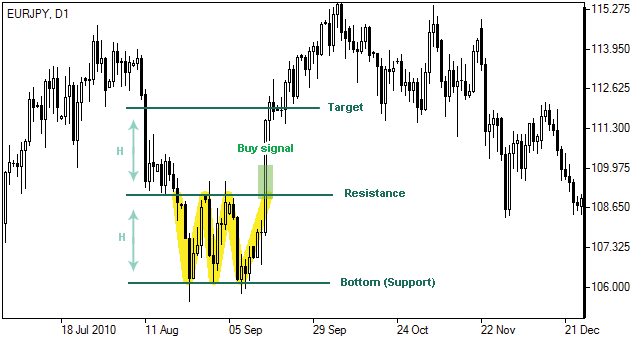
The triple bottom pattern is characterized by three consecutive lows located roughly at the same level and two highs between them. Support and resistance lines connect the lows and the tops respectively. The support is considered to be especially strong as the price reverses three times from the level where investors believe the asset is underpriced.
Interpretation of Triple Bottom Pattern
If the price climbs above the pattern’s tops or resistance level (plus certain deviation is possible), the formation is then completed and can be interpreted as change in direction of the trend upwards serving as a buy signal.
Triple Bottom Target Price
Following triple bottom pattern formation the price is generally believed to rise at least to its target level, calculated as follows:
T = R + H, Where:T – target level;
R – resistance level (recent local highs);
H – pattern’s height (distance between support and resistance levels).
Conclusion
The Triple Bottom Pattern offers traders a reliable way to spot potential trend reversals after a prolonged decline in price. Its three-test structure at a consistent support level provides stronger reversal evidence than patterns requiring fewer confirmations of buyer interest. Recognizing this pattern early can help traders position themselves ahead of a meaningful shift from bearish to bullish momentum.
Successful use of the pattern depends on waiting for a confirmed breakout above the resistance neckline rather than anticipating the move prematurely. Combining the pattern with volume analysis and sound risk management further improves the odds of a profitable outcome. As with any chart pattern, no signal guarantees success, so proper position sizing and stop-loss placement remain essential.
By mastering the formation, interpretation, and target-price calculation of the Triple Bottom Pattern, traders add a valuable tool to their technical analysis toolkit. Practicing pattern recognition on demo accounts before committing real capital helps build the confidence needed to trade it effectively. With patience and discipline, this pattern can become a dependable part of a broader trend-reversal trading strategy.
Forex Indicators FAQ
What is a Forex Indicator?
Forex technical analysis indicators are regularly used by traders to predict price movements in the Foreign Exchange market and thus increase the likelihood of making money in the Forex market. Forex indicators actually take into account the price and volume of a particular trading instrument for further market forecasting.
What are the Best Technical Indicators?
Technical analysis, which is often included in various trading strategies, cannot be considered separately from technical indicators. Some indicators are rarely used, while others are almost irreplaceable for many traders. We highlighted 5 the most popular technical analysis indicators: Moving average (MA), Exponential moving average (EMA), Stochastic oscillator, Bollinger bands, Moving average convergence divergence (MACD).
How to Use Technical Indicators?
Trading strategies usually require multiple technical analysis indicators to increase forecast accuracy. Lagging technical indicators show past trends, while leading indicators predict upcoming moves. When selecting trading indicators, also consider different types of charting tools, such as volume, momentum, volatility and trend indicators.
Do Indicators Work in Forex?
There are 2 types of indicators: lagging and leading. Lagging indicators base on past movements and market reversals, and are more effective when markets are trending strongly. Leading indicators try to predict the price moves and reversals in the future, they are used commonly in range trading, and since they produce many false signals, they are not suitable for trend trading.

Not sure about your Forex skills level?
Take a Test and We Will Help You With The Rest
You can see the graphical object on the price chart by downloading one of the trading terminals offered by IFC Markets.



Was this article helpful?

 You can study CFD trading more thoroughly and see CFD trading examples in the section How To Trade CFDs Visit Educational Center